What Does NAD Do in the Body?



What does NAD do in the body? Learn more about how NAD works, NAD+ benefits, and why everyone is talking about NAD supplements.
- What does NAD do in the body? NAD (nicotinamide adenine dinucleotide) is a coenzyme found in every cell of the body, playing a role in cellular energy production and more.
- NAD+ levels naturally decline with age, which has driven growing interest in NAD supplements like NMN and NR as a way to support normal cellular processes.
- NAD supports several key bodily functions, including aiding in energy production, helping regulate metabolism, and protecting genetic material.
- While early research on NAD benefits is promising, most studies are still in early stages; this is why it’s important to consult with a licensed healthcare provider before starting any supplement.
This article is for informational purposes only and is not intended as medical advice, diagnosis, or treatment. NAD supplements are not FDA-approved to treat, cure, or prevent any disease. Always consult a qualified healthcare provider before beginning any new supplement or treatment. Individual results may vary.
How Does NAD Work? Why Is It So Popular?
In various forums and discussions, NAD has been crowned the “longevity” supplement. Yet, we all know how persuasive good marketing can be. So, beyond the marketing, what does NAD actually do in the body?
NAD, short for nicotinamide adenine dinucleotide, is a molecule your cells have relied on for as long as you’ve been alive. It keeps your mitochondria running, helps repair genetic damage, and plays a role in nearly every major metabolic process your body carries out. However, increasing age is associated with a decline in NAD in the body, and researchers continue to be interested in what that means for long-term health.
{{primary-cta}}
NAD Functions in Your Body
Simply put, NAD acts as a coenzyme, essentially a helper molecule that enzymes need to do their jobs. So, again, what exactly does it do? Here’s a breakdown of its role in your body,
Cellular Energy
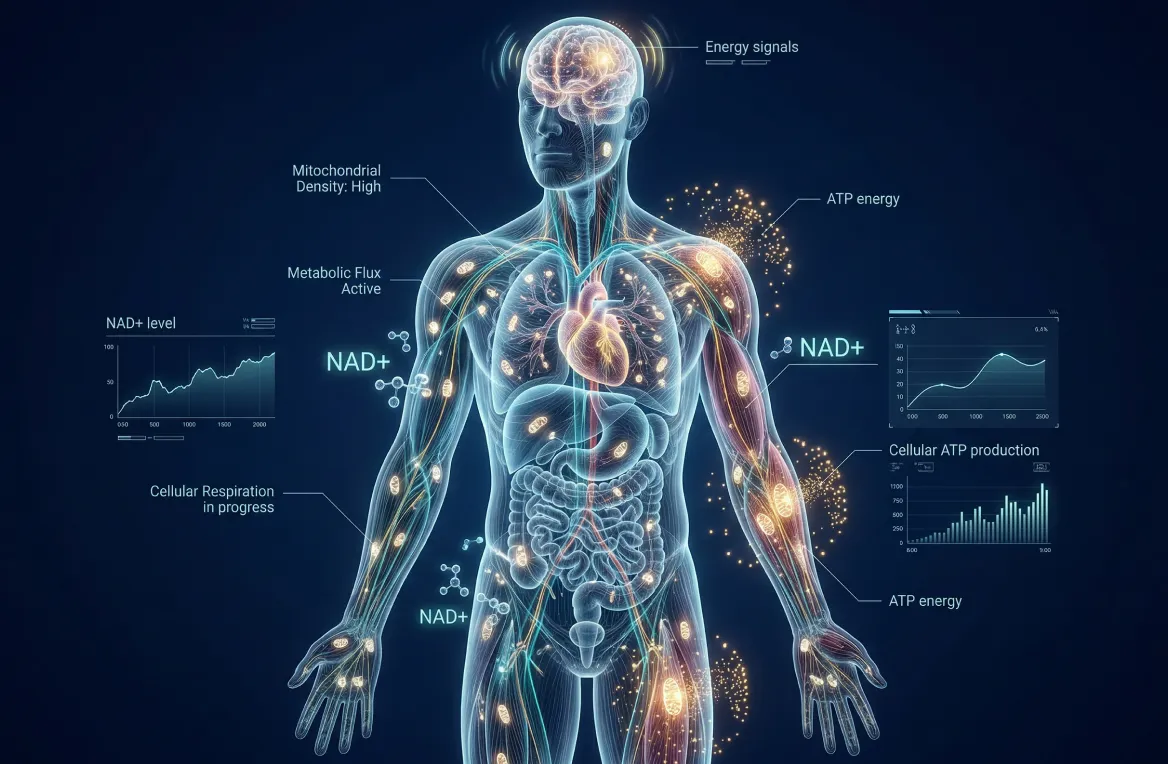
At its most fundamental level, NAD is what makes energy production possible. It shuttles electrons through a process called the electron transport chain inside your mitochondria, which ultimately generates cellular energy in the form of ATP.
DNA Maintenance
Every day, your DNA sustains thousands of small errors from environmental stressors, UV exposure, and normal cellular activity. However, NAD+ supports a family of proteins called PARPs (poly ADP-ribose polymerases), which are responsible for detecting and repairing that damage.
Without enough NAD+, DNA repair becomes less efficient, which may contribute to changes in cellular function over time.
Cellular Signaling
NAD also plays a role in cell signaling, particularly through a class of proteins called sirtuins. Sirtuins depend on NAD+ to function. They help regulate gene expression, manage inflammation, and coordinate how cells respond to stress.
Metabolic Function
From processing carbohydrates to breaking down fats and amino acids, NAD is involved in virtually every metabolic pathway your body runs. It helps convert the nutrients from the food you eat into usable energy and plays a role in maintaining normal metabolic processes.
NAD+ Benefits: What the Research Says
It's worth noting that much of this research has been conducted in animals or in small human trials, so the evidence remains limited. Research is still evolving, but here’s what early studies suggest.
Age-Related Cellular Function
Researchers have taken a growing interest in the relationship between NAD+ and aging, largely because levels appear to decline naturally over time. Some studies suggest this decline may be associated with changes in cellular function that occur as we age.
Early animal studies have explored whether supporting NAD+ levels could influence these processes, and while findings have been of interest to the research community, most human studies to date have been small and short-term. More large-scale clinical research is needed before any conclusions can be drawn about NAD+ supplementation in humans.
Cognitive Function and Mental Clarity
The brain is one of the most energy-demanding organs in the body, making it particularly sensitive to shifts in NAD+ availability. Some research points to a potential link between NAD+ and neuroprotection. Yet, at this stage, evidence in humans is very limited.
Metabolic and Blood Sugar Regulation
A handful of clinical studies have examined NAD supplementation in the context of metabolic health, with some showing improvements in insulin sensitivity and markers of metabolic function.
Physical Recovery and Muscle Function
Research exploring NAD+’s role in skeletal muscle homeostasis suggests that NAD+ levels may influence mitochondrial function and muscle repair processes, particularly as natural production declines with age. However, findings to date are largely preclinical, and more human research is needed.
Should You Take NAD Supplements?
Because NAD itself doesn’t absorb well when taken orally, most supplements use precursor molecules that the body can convert into NAD+. The two most researched are nicotinamide riboside (NR) and nicotinamide mononucleotide (NMN). However, it’s a good idea to talk with a licensed healthcare provider before adding any new supplement to your routine, especially if you have pre-existing health conditions or take prescription medication.
NAD may also be administered in certain clinical settings through injectable or IV formulations. These methods are typically administered by licensed healthcare providers and may be appropriate for certain individuals depending on their health history and goals.
If you’re curious as to how you can better achieve your health goals, start with Eden’s brief online intake. We’ll then connect you to a licensed provider who can review your health history and determine what’s best for you and your health.
Depending on your provider’s clinical evaluation, treatment options may include different delivery formats, such as nasal sprays, injections, or topical formulations like face creams. Your licensed provider will determine whether a therapy and its delivery method may be appropriate for your individual needs.
{{primary-cta}}
How to Support NAD Levels Naturally
Supplements aside, certain lifestyle habits may help your body maintain healthier NAD+ levels on its own. While research is still evolving, here are some areas that have drawn interest:
- Exercise regularly: Endurance and resistance training have both been associated with increased NAD+ synthesis in skeletal muscle, making physical activity one of the more well-supported natural approaches.
- Try intermittent fasting or caloric restriction: These dietary approaches have been linked to increased NAD+ availability, likely through their effects on metabolic pathways, though individual responses may vary.
- Eat niacin-rich foods: Foods high in vitamin B3, such as turkey, tuna, salmon, and avocado, provide precursors your body uses to synthesize NAD.
- Prioritize quality sleep: NAD plays a role in circadian rhythm regulation, and poor sleep may disrupt the metabolic processes that support healthy NAD+ levels.
- Reduce alcohol consumption: Excessive alcohol intake has been associated with faster NAD+ depletion, as the body uses NAD+ during alcohol metabolism.
Final Thoughts
Researchers continue to study how NAD+ influences the processes that keep cells functioning as we age. Interest in NAD+ supplementation has grown alongside this research, but, at the same time, it’s worth noting that supplements are not FDA-approved to treat, cure, or prevent any disease. The evidence in humans is still developing.
If you’re wondering whether NAD supplementation is appropriate for your health goals, a licensed healthcare provider is your best resource.









The FDA does not approve compounded medications for safety, quality, or manufacturing. Prescriptions and a medical evaluation are required for certain products. The information provided on this blog is for general informational purposes only. It is not intended as a substitute for professional advice from a qualified healthcare professional and should not be relied upon as personal health advice. The information contained in this blog is not meant to diagnose, treat, cure, or prevent any disease. Readers are advised to consult with a qualified healthcare professional for any medical concerns, including side effects. Use of this blog's information is at your own risk. The blog owner is not responsible for any adverse effects or consequences resulting from the use of any suggestions or information provided in this blog.
Eden is not a medical provider. Eden connects individuals with independent licensed healthcare providers who independently evaluate each patient to determine whether a prescription treatment program is appropriate. All prescriptions are written at the sole discretion of the licensed provider. Medications are filled by state-licensed pharmacies. Please consult a licensed healthcare provider before making any medical decisions.
Frequently asked questions
What does NAD+ do for the body?

NAD+ serves as a critical coenzyme involved in energy production, DNA repair, cell signaling, and metabolic regulation.
What are the signs of low NAD?
There are no definitive clinical symptoms tied specifically to low NAD, but fatigue, cognitive sluggishness, and slower recovery are areas researchers have explored in relation to declining NAD+ levels. A licensed healthcare provider can help assess whether supplementation may be appropriate for you.
Are NAD supplements safe?
NAD precursor supplements, such as NR and NMN, are reported in some studies to be well-tolerated, with mild digestive discomfort being the most commonly reported side effect. As with any supplement, it’s best to consult a healthcare provider before starting, particularly if you have existing health conditions or take medications.
Related articles









Elhassan, Y. S., Philp, A. A., & Lavery, G. G. (2017). Targeting NAD+ in Metabolic Disease: New Insights Into an Old Molecule. Journal of the Endocrine Society, 1(7), 816–835. https://pmc.ncbi.nlm.nih.gov/articles/PMC5686634/
Goody, M. F., & Henry, C. A. (2018). A need for NAD+ in muscle development, homeostasis, and aging. Skeletal muscle, 8(1), 9. https://pmc.ncbi.nlm.nih.gov/articles/PMC5840929/
Paiva, B. S., Neves, D., Tomé, D., Costa, F. J., Bruno, I. C., Trigo, D., Silva, R. M., & Almeida, R. D. (2025). Neuroprotection by Mitochondrial NAD Against Glutamate-Induced Excitotoxicity. Cells, 14(8), 582. https://pmc.ncbi.nlm.nih.gov/articles/PMC12025592/
Ruszkiewicz, J. A., Bürkle, A., & Mangerich, A. (2022). Fueling genome maintenance: On the versatile roles of NAD+ in preserving DNA integrity. The Journal of biological chemistry, 298(6), 102037. https://pmc.ncbi.nlm.nih.gov/articles/PMC9194868/
Santos, L., Benitez-Rosendo, A., Bresque, M., Camacho-Pereira, J., Calliari, A., & Escande, C. (2023). Sirtuins: The NAD+-Dependent Multifaceted Modulators of Inflammation. Antioxidants & redox signaling, 39(16-18), 1185–1208.https://pubmed.ncbi.nlm.nih.gov/37767625/
Thank you!
We'll be in touch.
Thank you!