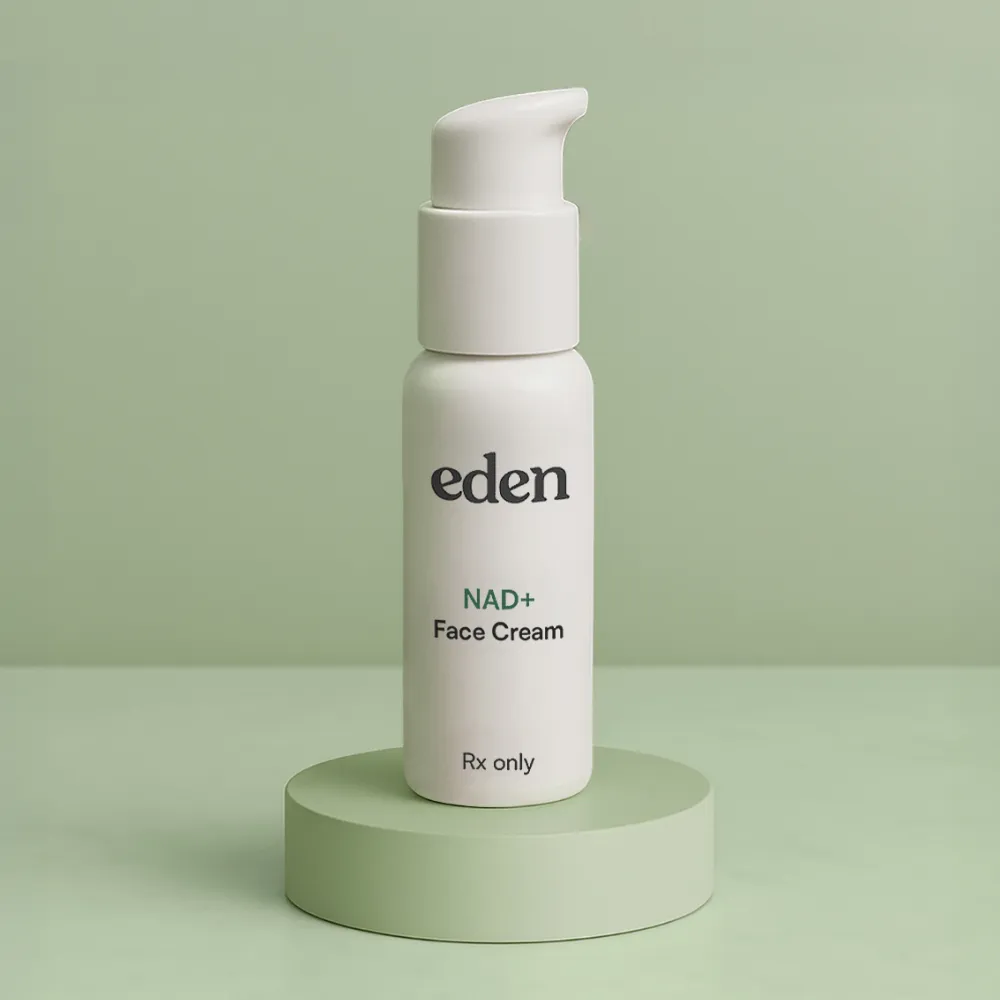
NAD Face Cream: Benefits and How It Works


.webp)

NAD face cream may support skin health by replenishing a coenzyme tied to cell repair and hydration. Here’s what the research currently suggests.
- Most NAD face creams use precursor ingredients such as NMN, niacinamide, or nicotinamide riboside rather than NAD+ itself, which is too unstable to penetrate the skin effectively on its own.
- NAD+ is a coenzyme found in every cell that powers energy production and DNA repair, and levels decline with age, which may contribute to changes in skin appearance over time.
- Regular use may support skin hydration and barrier function and may help support the skin’s response to environmental stressors.
- NAD face cream works best as part of a consistent routine, paired with complementary ingredients such as peptides, ceramides, and vitamin C as part of a balanced skincare routine.
This article is for informational purposes only and is not a substitute for professional medical advice. Consult a qualified healthcare provider before starting any new skincare or wellness regimen. Compounded medications, including any compounded NAD+ formulations, are not FDA-approved.
How Does NAD Face Cream Work?
By age 40, NAD+ levels in the body may decline compared to earlier adulthood. NAD+, or nicotinamide adenine dinucleotide, is a coenzyme present in every living cell, and it does a lot of heavy lifting—supporting cellular energy production and DNA repair. Thus, it plays an important role in overall skin health.
As we age, NAD+-consuming enzymes, such as CD38 and PARP, become increasingly active—driven by accumulated DNA damage, oxidative stress, and chronic low-level inflammation—while the body’s ability to produce NAD+ gradually slows down.
NAD face cream is intended to support the skin’s overall health and appearance. However, the NAD molecule is large, polar, and unstable. It degrades when exposed to light and air, and without a specialized delivery system, it struggles to reach the deeper skin layers where living cells can actually use it.
The most effective solutions often include precursor ingredients. Instead of applying NAD+ directly, these products contain smaller, more stable molecules, such as nicotinamide mononucleotide (NMN), nicotinamide riboside (NR), or niacinamide. In turn, these molecules may be absorbed by the skin and participate in cellular metabolic pathways associated with NAD+. Some formulations also use liposomal encapsulation, wrapping NAD+ in a lipid layer to potentially support ingredient delivery.
Once inside the cell, NAD+ helps activate two key enzyme families:
- Sirtuins, which are associated with cellular maintenance processes.
- PARP enzymes, which coordinate DNA damage repair after UV exposure.
In other words, NAD face cream is formulated to support cellular processes that may be associated with skin health and appearance.
{{primary-cta}}
Benefits of NAD Face Cream
Here’s what the research shows.
May Support Collagen
NAD+ is thought to help activate sirtuins, enzymes that are involved in cellular processes related to skin structure. These enzymes may support fibroblasts, the cells responsible for producing collagen, while also influencing pathways associated with collagen turnover.
May Reduce Visible Signs of Aging
As NAD+ levels decline with age, the skin may become more vulnerable to fine lines, dullness, and loss of elasticity. NAD+ levels are being studied for their potential role in cellular responses to UV exposure and oxidative stress.
By potentially supporting the skin’s natural repair capacity, NAD face cream may help address some of the visible changes that come with age; however, results vary and aren’t guaranteed.
May Improve Hydration and Skin Barrier Function
A well-functioning skin barrier is essential for holding moisture in and keeping irritants out. NAD+ is involved in cellular metabolic pathways that may influence skin barrier processes, which could help reduce transepidermal water loss and improve your skin’s hydration retention.
This may be especially relevant for skin that feels dry, tight, or reactive; a stronger barrier means ingredients stay in and environmental aggressors stay out.
May Protect Against Environmental and UV Damage
NAD+ may play a role in reducing oxidative stress caused by UV exposure and environmental pollutants. Preliminary research indicates it may be involved in cellular pathways associated with oxidative stress responses after UV exposure.
Yet, this protective function doesn’t replace SPF, but it may help your skin recover more effectively from daily environmental exposure.
May Aid Cellular Repair and DNA Protection
PARP enzymes, which NAD+ helps support as a cofactor, are your skin’s primary responders to DNA damage. When UV rays or environmental stressors cause cellular damage, PARP enzymes help coordinate the repair process. Thus, adequate NAD+ levels may support these processes as well.
Face Cream Through Eden
NAD face cream is designed to support a simple, consistent skincare routine focused on hydration and maintaining healthy-looking skin. Many people interested in skincare use face creams as part of their daily routine to support the skin barrier and maintain moisture.
Through Eden, individuals can start by completing a brief online intake, which helps connect them with a licensed healthcare provider who can review their goals and discuss available options, including skincare products like NAD Face Cream that may complement a broader wellness routine. Used consistently alongside habits like sun protection and gentle cleansing, a face cream can be one part of maintaining balanced, well-cared-for skin.
Fitting NAD Face Cream Into Your Skincare Routine
NAD face cream can be used in the evening or morning. Ideally, it goes on in the evening before your night cream. If your formula doubles as a moisturizer, use it in place of that step.
Niacinamide is one of the most common NAD+ precursors you’ll find in face creams. Beyond its role as a NAD+ building block, niacinamide is well-studied for improving skin tone, minimizing pores, and strengthening the barrier.
Here’s a basic morning routine using NAD face cream:
- Gentle cleanser
- Toner (optional)
- NAD face cream or NAD+ serum
- Moisturizer (if your NAD cream isn't also a moisturizer)
- SPF 30 or higher (always last)
For a PM skincare routine, here’s a fairly straightforward one:
- Cleanser (double cleanse if wearing SPF or makeup)
- Treatment serum (vitamin C [let fully absorb first], retinoid, or NAD+)
- NAD face cream
- Night moisturizer or facial oil
NAD face cream is generally compatible with peptides, ceramides, vitamin C, hyaluronic acid, and retinoids, meaning you don’t have to worry about the order too much. Just ensure that each product is fully absorbed first before applying the next.
At the same time, high-alcohol formulations and synthetic fragrances can compromise skin tolerance and offset the barrier benefits you’re working toward. It’s also worth considering the packaging since the NAD molecule degrades with light and air exposure.
Final Thoughts
NAD face cream is being explored as part of skincare routines focused on skin health and appearance; however, NAD research remains fairly limited. If you have any concerns about your skin health or routine, it may be best to discuss your options with a dermatologist who can perform a proper assessment and determine what’s right for you. They can also point you toward specific products that may be more appropriate for your skincare goals.









The FDA does not approve compounded medications for safety, quality, or manufacturing. Prescriptions and a medical evaluation are required for certain products. The information provided on this blog is for general informational purposes only. It is not intended as a substitute for professional advice from a qualified healthcare professional and should not be relied upon as personal health advice. The information contained in this blog is not meant to diagnose, treat, cure, or prevent any disease. Readers are advised to consult with a qualified healthcare professional for any medical concerns, including side effects. Use of this blog's information is at your own risk. The blog owner is not responsible for any adverse effects or consequences resulting from the use of any suggestions or information provided in this blog.
Eden is not a medical provider. Eden connects individuals with independent licensed healthcare providers who independently evaluate each patient to determine whether a prescription treatment program is appropriate. All prescriptions are written at the sole discretion of the licensed provider. Medications are filled by state-licensed pharmacies. Please consult a licensed healthcare provider before making any medical decisions.
Frequently asked questions
Does NAD face cream actually work?

NAD face cream is being studied for its potential role in cellular metabolism and skin health, particularly when formulated with stable precursors like NMN, NR, or niacinamide.
What ingredients should I look for in an NAD face cream?
Look for precursor ingredients, such as NMN, nicotinamide riboside, or niacinamide, on the label, along with supporting ingredients like peptides, ceramides, and hyaluronic acid. Also, make sure to choose products in airless or opaque packaging to maintain stability.
Can I use NAD face cream with retinol or vitamin C?
Yes, NAD face cream pairs well with both retinoids and vitamin C; if using a retinoid, introduce it gradually and monitor for any sensitivity.
Where does NAD face cream fit in my skincare routine?
Apply it after cleansing and before moisturizer or SPF in the morning, and before your night cream in the evening; make sure you always apply it on clean, dry skin.
Related articles

.webp)
.webp)
.webp)
.webp)


Baohua, Y., & Li, L. (2012). Effects of SIRT6 silencing on collagen metabolism in human dermal fibroblasts. Cell biology international, 36(1), 105–108. https://pubmed.ncbi.nlm.nih.gov/21981042/
Imai, S., & Guarente, L. (2014). NAD+ and sirtuins in aging and disease. Trends in cell biology, 24(8), 464–471. https://pmc.ncbi.nlm.nih.gov/articles/PMC4112140/
Katayoshi, T., Nakajo, T., & Tsuji-Naito, K. (2021). Restoring NAD+ by NAMPT is essential for the SIRT1/p53-mediated survival of UVA- and UVB-irradiated epidermal keratinocytes. Journal of photochemistry and photobiology. B, Biology, 221, 112238. https://pubmed.ncbi.nlm.nih.gov/34130091/
Li, M., Zhang, M., Zhang, Y., Liang, Y., & Ying, W. (2023). NAD+ administration profoundly decreases UVC-induced skin damage by attenuating oxidative stress, inflammation, DNA damage and apoptosis. International journal of physiology, pathophysiology and pharmacology, 15(2), 41–49. https://pmc.ncbi.nlm.nih.gov/articles/PMC10195211/
Martínez-Gutiérrez, A., Fernández-Duran, I., Marazuela-Duque, A., Simonet, N. G., Yousef, I., Martínez-Rovira, I., Martínez-Hoyos, J., & Vaquero, A. (2021). Shikimic acid protects skin cells from UV-induced senescence through activation of the NAD+-dependent deacetylase SIRT1. Aging, 13(9), 12308–12333. https://pubmed.ncbi.nlm.nih.gov/33901008/
McReynolds, M. R., Chellappa, K., & Baur, J. A. (2020). Age-related NAD+ decline. Experimental gerontology, 134, 110888. https://pmc.ncbi.nlm.nih.gov/articles/PMC7442590/
Murata, M. M., Kong, X., Moncada, E., Chen, Y., Imamura, H., Wang, P., Berns, M. W., Yokomori, K., & Digman, M. A. (2019). NAD+ consumption by PARP1 in response to DNA damage triggers metabolic shift critical for damaged cell survival. Molecular biology of the cell, 30(20), 2584–2597. https://pmc.ncbi.nlm.nih.gov/articles/PMC6740200/
Załęcki, P., Jezusek, J., & Nowicka, D. (2025). Topical Niacinamide in Daily Skincare: A 3-Week Real-World Cosmetic Study. Applied Sciences, 15(17), 9729. https://www.mdpi.com/2076-3417/15/17/9729
Thank you!
We'll be in touch.
Thank you!