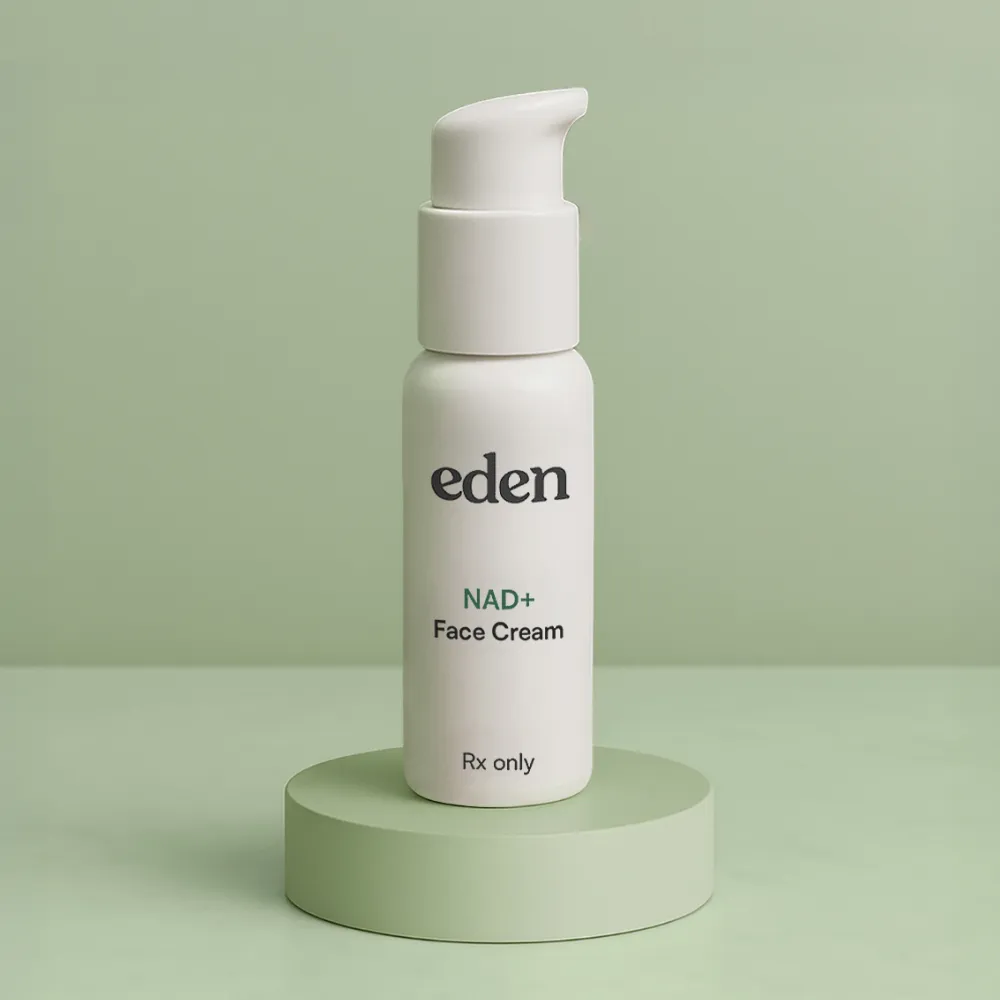
NAD for Skin: Does It Really Make a Difference?



Considering NAD for skin health? Here’s what NAD+ actually does for your skin, how it supports cellular repair, and its role in skin elasticity and tone.
- NAD for skin care and health is a growing topic. This coenzyme may play a role in how your skin cells produce energy, repair damage, and maintain their overall health.
- Your NAD+ levels naturally decline with age, which may affect your skin.
- Environmental stressors such as UV exposure, pollution, and chronic inflammation can accelerate NAD+ depletion, leaving your skin cells with less fuel to work with.
- There are several ways to support NAD+ levels, from oral precursors such as NMN and NR to topical ingredients such as niacinamide.
- NAD+ may be supportive when used as part of a broader skincare and wellness routine. Pairing it with proven ingredients and healthy habits may support overall skin health.
This content is for informational purposes only and is not intended as medical advice. Always consult a qualified healthcare provider before starting any new supplement or treatment. Individual results may vary.
What Does NAD+ Do for Your Skin?
Your skin is the largest organ in your body. It’s also your first line of defense against UV rays, pollution, germs, and environmental stress. Every day, your skin cells are regenerating, repairing damage, producing proteins such as collagen and elastin, and maintaining your skin barrier. All of that requires a constant supply of energy and resources.
NAD+ (nicotinamide adenine dinucleotide) is a coenzyme that exists in every cell of your body. It’s involved in hundreds of biological processes, but two of the most relevant for your skin are energy production and cellular repair. NAD+ also supports the function of enzymes called sirtuins, which are involved in DNA repair and cellular health.
{{primary-cta}}
What Happens to Your Skin When NAD+ Levels Drop?
Your body doesn’t maintain the same NAD+ levels forever. Research shows that NAD+ concentrations in the skin may decrease by at least 50% over the course of adulthood.
When NAD+ levels dip, your skin cells have less energy to do their jobs. DNA repair may slow down. Collagen and elastin production may decrease. Cell turnover may also become slower. With age, many people notice dullness, uneven texture, loss of firmness, or skin that no longer bounces back the way it used to.
Environmental factors can also accelerate this process. UV exposure triggers enzymes called PARPs that consume NAD+ while repairing DNA damage. On top of this, chronic, low-grade inflammation activates another enzyme, CD38, which further depletes your NAD+ reserves. In other words, it’s not just time working against you. Stress, sun exposure, and environmental pollutants accumulate, and so may the toll these external factors have on NAD+ levels.
NAD+ Benefits for Skin
So, what can healthy NAD+ levels actually do for your skin?
Cellular Repair and Regeneration
Your skin faces daily damage from UV rays, pollution, and normal metabolic activity. NAD+ supports the enzymes responsible for repairing that damage at the DNA level, including a family of enzymes, mentioned above, called PARPs, that rely on NAD+ to repair UV-induced DNA damage in human skin cells. When NAD+ production is blocked, cells may lose their ability to recover from that damage.
NAD+ also directly regulates protein interactions involved in DNA repair, and boosting NAD+ levels with precursors, such as NMN, has been shown to reduce DNA damage in animal models.
Collagen and Elastin Support
Collagen and elastin are the proteins that give your skin its structure and bounce. So, how do these two intersect?
The NAD+-dependent enzyme SIRT6 promotes genes associated with collagen production, while both SIRT1 and SIRT6 help inhibit MMP-1, an enzyme that breaks down collagen. Both SIRT1 and SIRT6 are downregulated in older skin, which correlates with declining NAD+ levels.
As NAD+ decreases, fibroblasts (the cells responsible for making collagen and elastin) can become senescent, meaning they essentially stop doing their job.
Skin Barrier and Hydration
Your skin barrier helps retain moisture and protects against external irritants. Maintaining it requires cellular energy and balanced skin function. NAD+ plays a role in cellular energy metabolism, which is involved in many normal cellular processes within the skin.
Protection Against Oxidative Stress
Oxidative stress occurs when free radicals outpace your body’s ability to neutralize them. However, in human fibroblasts, NAD+ has been linked with protective effects against UV-induced oxidative stress through improved sirtuin activation and mitochondrial function.
{{primary-cta}}
How to Support NAD+ Levels for Your Skin
If NAD+ is so important, the natural next question is: how do you maintain or restore it? There are a few options you may want to explore.
NAD+ Precursors and Supplements (NMN, NR)
Your body doesn’t absorb NAD+ efficiently on its own, which is why researchers have focused on precursors. Precursors are molecules your body may be able to convert into NAD+. The two most studied are nicotinamide mononucleotide (NMN) and nicotinamide riboside (NR).
Early clinical research suggests that both NMN and NR may help support blood NAD+ levels, though results vary and further studies are needed. Some preliminary research has examined NMN’s potential role in helping skin cells regenerate NAD+, but this area remains in its early stages.
It’s important to note that NMN and NR supplements are not FDA-approved to treat, cure, or prevent any disease. As with any supplement, talk to a qualified healthcare provider before adding one to your routine.
Topical Options: What Works and What Doesn’t
You’ve probably seen NAD+ listed on skincare labels. But the NAD+ molecule itself is quite large (663 daltons), which makes it difficult for it to actually penetrate the skin barrier. Thus, many products that market themselves as NAD+ skincare actually use precursors or supporting ingredients instead.
Niacinamide (vitamin B3) is the most common and well-researched topical NAD+ precursor. It’s small enough to absorb into the skin and supports your cells’ natural NAD+ production. If you’re looking for a topical option, niacinamide-based products are commonly used in skincare routines.
IV and Injection Therapy
NAD+ can also be delivered through IV infusions or injections. Because NAD+ products are not FDA-approved for skin-related indications, individuals considering this option should consult a licensed healthcare provider on the Eden platform to discuss potential risks, benefits, and alternatives.
Final Thoughts
At the end of the day, research on NAD+ benefits for skin is still evolving, but what we know so far is promising, particularly for supporting cellular repair, collagen production, and overall skin resilience.
If you’re considering NAD+ supplements or therapy, talk to a licensed healthcare provider on the Eden platform or your dermatologist first. They can help you weigh the options, flag any potential side effects or interactions, and find an approach that makes sense for your skin and your health.









The FDA does not approve compounded medications for safety, quality, or manufacturing. Prescriptions and a medical evaluation are required for certain products. The information provided on this blog is for general informational purposes only. It is not intended as a substitute for professional advice from a qualified healthcare professional and should not be relied upon as personal health advice. The information contained in this blog is not meant to diagnose, treat, cure, or prevent any disease. Readers are advised to consult with a qualified healthcare professional for any medical concerns, including side effects. Use of this blog's information is at your own risk. The blog owner is not responsible for any adverse effects or consequences resulting from the use of any suggestions or information provided in this blog.
Eden is not a medical provider. Eden connects individuals with independent licensed healthcare providers who independently evaluate each patient to determine whether a prescription treatment program is appropriate. All prescriptions are written at the sole discretion of the licensed provider. Medications are filled by state-licensed pharmacies. Please consult a licensed healthcare provider before making any medical decisions.
Frequently asked questions
Does NAD improve your skin?

NAD+ supports several processes that are important for skin health, including cellular repair, collagen production, and energy metabolism. However, results may vary depending on the delivery method and individual factors.
Is NAD better than collagen?
Ultimately, NAD and collagen work differently. Collagen supplements and topicals provide structural proteins directly. In contrast, NAD+ supports the cellular processes that drive collagen production.
Is NAD just vitamin B3?
No, niacinamide (a form of vitamin B3) is a precursor to NAD+, meaning your body can use it to produce NAD+. But NAD+ itself is a larger, more complex coenzyme involved in hundreds of cellular processes.
Can you absorb NAD through your skin?
Pure NAD+ is difficult to absorb topically because of its molecular size. This is why most effective NAD skincare products use smaller precursors, such as niacinamide, which can penetrate the skin and support NAD+ production from within.
Related articles

.webp)
.webp)
.webp)
.webp)
.webp)


Boo Y. C. (2021). Mechanistic Basis and Clinical Evidence for the Applications of Nicotinamide (Niacinamide) to Control Skin Aging and Pigmentation. Antioxidants (Basel, Switzerland), 10(8), 1315. https://doi.org/10.3390/antiox10081315
Camacho-Pereira, J., Tarragó, M. G., Chini, C. C. S., Nin, V., Escande, C., Warner, G. M., Puranik, A. S., Schoon, R. A., Reid, J. M., Galina, A., & Chini, E. N. (2016). CD38 Dictates Age-Related NAD Decline and Mitochondrial Dysfunction through an SIRT3-Dependent Mechanism. Cell metabolism, 23(6), 1127–1139. https://doi.org/10.1016/j.cmet.2016.05.006
Conlon N. J. (2022). The Role of NAD+ in Regenerative Medicine. Plastic and reconstructive surgery, 150(4 Suppl ), 41S–48S. https://doi.org/10.1097/PRS.0000000000009673
Haneklaus, M., O'Neil, J. D., Clark, A. R., Masters, S. L., & O'Neill, L. A. J. (2017). The RNA-binding protein Tristetraprolin (TTP) is a critical negative regulator of the NLRP3 inflammasome. The Journal of biological chemistry, 292(17), 6869–6881. https://doi.org/10.1074/jbc.M116.772947
Imai, S., & Guarente, L. (2014). NAD+ and sirtuins in aging and disease. Trends in cell biology, 24(8), 464–471. https://doi.org/10.1016/j.tcb.2014.04.002
Kang, S., Park, J., Cheng, Z., Ye, S., Jun, S. H., & Kang, N. G. (2024). Novel Approach to Skin Anti-Aging: Boosting Pharmacological Effects of Exogenous Nicotinamide Adenine Dinucleotide (NAD+) by Synergistic Inhibition of CD38 Expression. Cells, 13(21), 1799. https://doi.org/10.3390/cells13211799
Kang, S., Park, J., Cho, E., Kim, D., Ye, S., Jeong, E. T., Jun, S.-H., & Kang, N.-G. (2025). Distinctive Gene Expression Profiles and Biological Responses of Skin Fibroblasts to Nicotinamide Mononucleotide: Implications for Longevity Effects on Skin. Biomedicines, 13(10), 2395. https://doi.org/10.3390/biomedicines13102395
Katayoshi, T., Nakajo, T., & Tsuji-Naito, K. (2021). Restoring NAD+ by NAMPT is essential for the SIRT1/p53-mediated survival of UVA- and UVB-irradiated epidermal keratinocytes. Journal of photochemistry and photobiology. B, Biology, 221, 112238. https://doi.org/10.1016/j.jphotobiol.2021.112238
Massudi, H., Grant, R., Braidy, N., Guest, J., Farnsworth, B., & Guillemin, G. J. (2012). Age-Associated changes in oxidative stress and NAD+ metabolism in human tissue. PLoS ONE, 7(7), e42357. https://doi.org/10.1371/journal.pone.0042357
Okabe, K., Yaku, K., Uchida, Y., Fukamizu, Y., Sato, T., Sakurai, T., Tobe, K., & Nakagawa, T. (2022). Oral Administration of Nicotinamide Mononucleotide Is Safe and Efficiently Increases Blood Nicotinamide Adenine Dinucleotide Levels in Healthy Subjects. Frontiers in nutrition, 9, 868640. https://doi.org/10.3389/fnut.2022.868640
She, J., Sheng, R., & Qin, Z. H. (2021). Pharmacology and Potential Implications of Nicotinamide Adenine Dinucleotide Precursors. Aging and disease, 12(8), 1879–1897. https://doi.org/10.14336/AD.2021.0523
Yousef, H., Alhajj, M., Fakoya, A. O., & Sharma, S. (2024, June 8). Anatomy, skin (Integument), epidermis. StatPearls - NCBI Bookshelf. https://www.ncbi.nlm.nih.gov/books/NBK470464/
Zhang, J., Yu, H., Man, M. Q., & Hu, L. (2024). Aging in the dermis: Fibroblast senescence and its significance. Aging cell, 23(2), e14054. https://doi.org/10.1111/acel.14054
Thank you!
We'll be in touch.
Thank you!