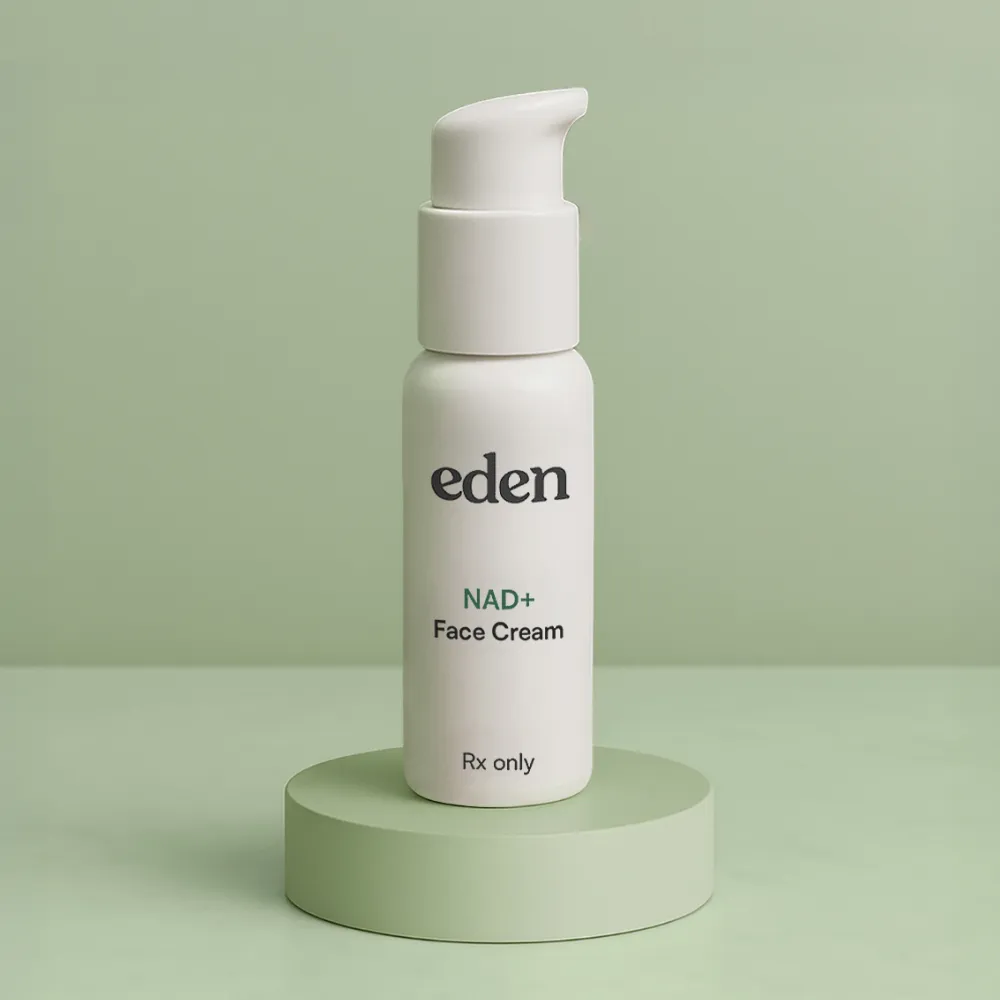
NAD+ Face Cream: What to Expect Over Time


.webp)

Wondering when NAD+ face cream starts working? Learn what changes to expect week by week, from early hydration improvements to longer-term skin repair results.
- Any potential results from NAD+ face cream are gradual; some people notice early hydration improvements within the first few weeks, while changes to firmness and fine lines may take longer. At the same time, results aren’t guaranteed.
- Outcomes may partly depend on the formulation, the quality of the precursor ingredients, and how consistently you apply it.
- Ingredients used in NAD+-related skincare formulations are often discussed in relation to cellular metabolism and skin health.
- Pairing NAD+ face cream with complementary ingredients, such as ceramides, peptides, and vitamin C, may support overall skin health.
- If your skin looks or feels worse after a few weeks, it may be worth reassessing the product or consulting a dermatologist.
This article is intended for educational purposes only and is not a substitute for professional medical advice. Consult a qualified healthcare provider before starting any new skincare or wellness regimen. Compounded medications, including any compounded NAD+ formulations, are not FDA-approved.
What Does NAD+ Face Cream Do?
NAD+ has become one of the most talked-about ingredients in skincare this past year, showing up in serums, creams, and treatments as part of a broader shift toward longevity-focused routines. But what does it actually do for your skin? And when would you realistically start to notice a difference?
NAD+, or nicotinamide adenine dinucleotide, is a coenzyme found in every cell in your body. This means it works alongside enzymes to trigger and speed up the chemical reactions your cells need to function. In the case of NAD+, it supports everything from energy production to DNA repair. So, how did NAD+ end up in the anti-aging space?
NAD+ declines with age. This has led many to explore NAD+ in relation to health, longevity, and overall wellness, including skincare.
However, the NAD molecule itself is large and unstable. It also breaks down with light and air exposure, and due to its size, it often doesn’t reach deep within the skin. And this is why most NAD+ face creams don’t actually contain any NAD+.
Instead, these creams and serums use precursor ingredients, smaller molecules such as niacinamide, nicotinamide mononucleotide (NMN), or nicotinamide riboside (NR).
Within cells, NAD+ precursors can be converted into NAD+, a molecule involved in cellular metabolism and DNA repair pathways. Because these biological processes occur gradually, visible skin changes from skincare products (if they occur) may take time to become noticeable.
{{primary-cta}}
What To Expect Over Time
So, what should you expect? How can NAD+ make a difference in your skin? Here’s a general timeline that some people may experience.
Week 1-2: What You Might Notice First
In the first week or two, don’t expect a dramatic transformation. With that in mind, some people note that hydration is usually the first thing that changes.
NAD+ precursors, such as niacinamide, are well-known for supporting the skin barrier and helping the skin retain moisture. If your skin tends to feel dry, tight, or reactive, you may notice it feeling more comfortable.
Texture can also improve in this early window. Some people report that their skin feels softer or looks a little smoother, though this varies by skin type, product formulation, and how your skin responds.
As with any new skincare product, mild redness or sensitivity can sometimes occur in the first few days, particularly if your skin isn’t used to active ingredients.
Yet, persistent irritation or breakouts that started after introducing the product may signal it’s not right for your skin. This is why it’s important for those with any skin issues or health conditions to consult a dermatologist before adding any new product.
Weeks 3-4: Early Signs of Improvement
By weeks three and four, you may start to see some early visible changes, such as your skin tone.
Niacinamide, one of the most common NAD+ precursors used in face creams, is commonly included in skincare formulations and has been studied for its potential role in improving the appearance of uneven skin tone and visible pores. These effects may start to become noticeable around this point with consistent use.
Months 2-3: Longer-Term Changes
Since skin renewal processes occur gradually, any visible changes from skincare products may take several weeks or months to appear.
NAD+ may help activate sirtuins, which are enzymes thought to support fibroblasts (the cells that produce collagen) and potentially inhibit MMP-1 (an enzyme that breaks collagen down). These processes are slow by nature. Simply put, collagen production and turnover don’t happen overnight.
Some research has explored the relationship between NAD+ pathways and cellular responses to oxidative stress and UV exposure. This isn’t something you’ll necessarily see in the mirror directly, but it may contribute to skin that feels more resilient and looks healthier overall.
At the same time, it’s worth noting that results aren’t guaranteed and will vary from person to person. Additionally, many factors play a role, such as age, baseline skin condition, product quality, and consistency.
What Affects Your Results
The following factors may impact whether or not you notice results:
- Formulation quality: Look for products that use stable precursor ingredients, such as NMN, nicotinamide riboside, or niacinamide.
- Packaging: Some skincare ingredients may degrade upon exposure to light and air. Airless pumps or opaque packaging help preserve the formula’s potency over time.
- Consistency: With consistent skincare use, visible changes may develop gradually over time.
- Supporting ingredients: Products that combine NAD+ precursors with complementary ingredients, such as ceramides for barrier support, peptides for collagen, hyaluronic acid for hydration, and vitamin C for antioxidant protection, may offer better overall results than those relying on a single active ingredient.
- Age and skin condition: Older skin or more damaged skin may take longer to respond, though it also has more room for improvement. Baseline hydration levels and skin type also influence how quickly changes show up.
Signs It’s Working (and Signs It Isn’t)
Signs it may be working include:
- Your skin feels more hydrated and plump, especially after cleansing.
- You experience fewer moments of tightness or sensitivity throughout the day.
- Your skin tone looks more even or less dull over time.
- Fine lines may appear slightly softer or less pronounced at the two to three-month mark.
- Your skin feels more resilient after sun exposure or stressful periods.
Signs it may not be the right fit include:
- Persistent breakouts or congestion that started when you introduced the product.
- Ongoing redness or sensitivity that doesn’t settle after the first few days.
- No change at all after two to three months of consistent use.
- The formula smells or feels off (a sign of instability or degradation).
If you’re not seeing any improvement after a full two to three-month trial, it may be worth reassessing the product, checking the ingredient list, or speaking with a dermatologist who can help identify what your skin actually needs.
If you’re unsure what skincare products may be appropriate for your skin concerns, consider consulting a licensed dermatologist or skincare professional.
Considering NAD+ Face Cream Options
If you're exploring NAD+ face cream as part of your skincare routine, product formulation and ingredient stability can make a difference in how the formula performs over time.
Eden offers an NAD+ face cream formulated with NAD-related ingredients commonly used in skincare, along with complementary components designed to support hydration and skin barrier function.
If you're curious about whether this type of product could fit into your routine, you can learn more about Eden’s NAD+ face cream and its formulation on the Eden website. You can also complete a brief online intake, and Eden can connect you with a licensed provider who can help determine whether this option aligns with your skincare goals.
{{primary-cta}}
How to Get the Most Out of Your NAD+ Face Cream
Here are a few practical tips when using NAD+ face cream:
- Apply NAD+ face cream to clean, dry skin for the best absorption.
- In the morning, follow NAD+ face cream with a moisturizer (if the cream isn’t also a moisturizer) and always finish with SPF 30 or higher.
- In the evening, use it after any treatment serums and before your night cream or facial oil.
NAD+ face cream can be part of a skincare routine involving peptides, ceramides, hyaluronic acid, vitamin C, and retinoids. However, if you’re introducing retinoids at the same time, add them gradually and watch for any sensitivities.
On the other hand, high-alcohol formulations and synthetic fragrances may undermine the barrier benefits you’re trying to build. Make sure to always check the full ingredient lists of your skincare products to ensure you’re building habits that align with your goals.
Final Thoughts
NAD+ and related precursor ingredients are often discussed in relation to cellular metabolism and skin biology. If you’re consistent with a well-formulated product, you may notice changes within the first few weeks or months. However, as aforementioned, results aren’t guaranteed and vary from person to person.
As always, if you have specific concerns about your skin or you’re unsure where NAD+ face cream fits into your routine, a dermatologist can provide more personalized advice.









The FDA does not approve compounded medications for safety, quality, or manufacturing. Prescriptions and a medical evaluation are required for certain products. The information provided on this blog is for general informational purposes only. It is not intended as a substitute for professional advice from a qualified healthcare professional and should not be relied upon as personal health advice. The information contained in this blog is not meant to diagnose, treat, cure, or prevent any disease. Readers are advised to consult with a qualified healthcare professional for any medical concerns, including side effects. Use of this blog's information is at your own risk. The blog owner is not responsible for any adverse effects or consequences resulting from the use of any suggestions or information provided in this blog.
Eden is not a medical provider. Eden connects individuals with independent licensed healthcare providers who independently evaluate each patient to determine whether a prescription treatment program is appropriate. All prescriptions are written at the sole discretion of the licensed provider. Medications are filled by state-licensed pharmacies. Please consult a licensed healthcare provider before making any medical decisions.
Frequently asked questions
How long does NAD+ face cream take to work?

Some people report changes in the first few weeks or months. However, timelines can vary from person to person, and results aren’t guaranteed.
Is it normal for skin to look worse before it gets better?
Mild sensitivity or slight redness in the first few days can be normal as your skin adjusts. Persistent breakouts or ongoing irritation are less typical and may be a sign the product isn’t the right fit for your skin.
What should I look for in an NAD+ face cream?
Prioritize products with stable precursor ingredients (NMN, nicotinamide riboside, or niacinamide), supportive ingredients like ceramides and peptides, and packaging that protects the formula from air and light exposure.
Does NAD+ face cream replace SPF?
While research has explored NAD-related pathways involved in cellular stress responses, NAD+ face cream doesn’t replace sunscreen. Make sure to apply SPF 30 or higher as the last step of your morning routine.
Related articles

.webp)
.webp)
.webp)
.webp)


Baohua, Y., & Li, L. (2012). Effects of SIRT6 silencing on collagen metabolism in human dermal fibroblasts. Cell biology international, 36(1), 105–108. https://pubmed.ncbi.nlm.nih.gov/21981042/
Li, M., Zhang, M., Zhang, Y., Liang, Y., & Ying, W. (2023). NAD+ administration profoundly decreases UVC-induced skin damage by attenuating oxidative stress, inflammation, DNA damage and apoptosis. International journal of physiology, pathophysiology and pharmacology, 15(2), 41–49. https://pmc.ncbi.nlm.nih.gov/articles/PMC10195211/
Martínez-Gutiérrez, A., Fernández-Duran, I., Marazuela-Duque, A., Simonet, N. G., Yousef, I., Martínez-Rovira, I., Martínez-Hoyos, J., & Vaquero, A. (2021). Shikimic acid protects skin cells from UV-induced senescence through activation of the NAD+-dependent deacetylase SIRT1. Aging, 13(9), 12308–12333. https://pubmed.ncbi.nlm.nih.gov/33901008/
Murata, M. M., Kong, X., Moncada, E., Chen, Y., Imamura, H., Wang, P., Berns, M. W., Yokomori, K., & Digman, M. A. (2019). NAD+ consumption by PARP1 in response to DNA damage triggers metabolic shift critical for damaged cell survival. Molecular biology of the cell, 30(20), 2584–2597. https://pmc.ncbi.nlm.nih.gov/articles/PMC6740200/
Załęcki, P., Jezusek, J., & Nowicka, D. (2025). Topical Niacinamide in Daily Skincare: A 3-Week Real-World Cosmetic Study. Applied Sciences, 15(17), 9729. https://www.mdpi.com/2076-3417/15/17/9729
Thank you!
We'll be in touch.
Thank you!