Tirzepatide Dosage Chart for Weight Loss (Units + Maintenance)



Tirzepatide dosage chart for weight loss with a week-by-week schedule, Zepbound® maintenance dose options, missed-dose rules, and how tirzepatide dosing for weight loss in units is calculated from your label concentration.
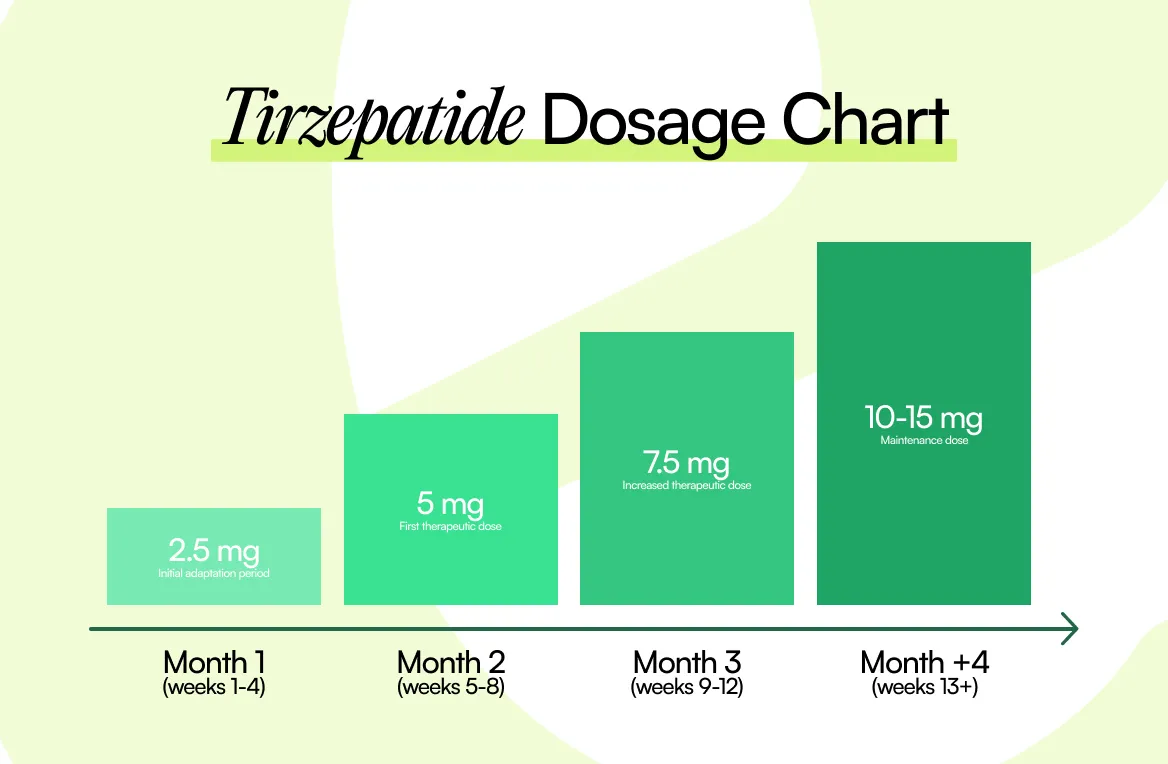
- On a typical tirzepatide dosage chart, the step-up schedule starts 2.5 mg once weekly for 4 weeks, then increases to 5 mg once weekly. Doses may be increased in 2.5 mg steps after at least 4 weeks at each dose, but this depends on how the medication is tolerated and whether a higher dose is even needed.
- For chronic weight management, recommended Zepbound® maintenance doses are 5 mg, 10 mg, or 15 mg once weekly (your prescriber selects based on tolerability and clinical goals).
- Zepbound® dose / tirzepatide maintenance dose: “Maintenance” usually means staying on the lowest effective, tolerated weekly dose long term—some people remain at 5 mg; others escalate.
- Tirzepatide dosing for weight loss in units depends on your vial’s concentration (mg/mL). Since ‘units’ measure volume (how much liquid), you can only convert your prescribed mg dose into units using the mg/mL shown on your pharmacy label.
Note: This is general education, not medical advice. If you receive a compounded medication, it is not FDA-approved and is prescribed only when clinically appropriate based on a prescriber’s determination.
How Dosing Works
Tirzepatide dosing for weight loss usually increases slowly to allow your body time to adjust to the medication. The dosage chart below shows the usual weekly schedule and maintenance dose range from the FDA-approved prescribing information. Your prescriber may change your schedule based on how you tolerate the medicine, your health history, and the product you use.
Tirzepatide Dosage Chart: Weekly Titration Schedule
The general rule is to increase by 2.5 mg at a time and stay at each dose at least 4 weeks before increasing again (unless your prescriber advises otherwise for your specific situation).
{{primary-cta}}
Zepbound® Dose for Weight Loss
Zepbound® (tirzepatide) is FDA-approved for chronic weight management.
A typical schedule is:
- 2.5 mg once weekly for 4 weeks
- Increase to 5 mg once weekly
- If needed and tolerated, increase in 2.5 mg increments after at least 4 weeks on the current dose
- The maximum recommended dose is 15 mg once weekly
Zepbound® Maintenance Dose
The Zepbound® maintenance dose refers to the weekly dose that you’ll continue long term after titrating up. The maintenance dose amount is determined by your prescriber and may include:
- 5 mg once weekly
- 10 mg once weekly
- 15 mg once weekly
If you are experiencing side effects on a maintenance dose, a prescriber may recommend staying at a lower, better-tolerated maintenance dose.
Mounjaro® Dose for Weight Loss
Mounjaro® is FDA-approved for type 2 diabetes, not weight loss. But in some cases, a clinician may use it off-label to support weight management. Most people want to know the long-term weekly dose after titration. The schedule typically starts at 2.5 mg weekly for 4 weeks, then 5 mg weekly, with optional 2.5 mg increases after at least 4 weeks per step if needed and tolerated. The maximum dose for Mounjaro® is also 15 mg once weekly. The last step is for your prescriber to determine the maintenance dose.
What Happens After You Reach A Maintenance Dose?
Once you’re on a steady weekly dose, follow-ups usually focus on two things: how well the dose fits your life and how you’re tolerating it. If progress stalls or side effects become difficult to manage, your prescriber may adjust the weekly dose or recommend changes to your diet, activity, or other medications that may affect results.
What to track between visits:
- Side effects and when they happen after the injection
- Appetite changes and whether you’re meeting protein/hydration goals
- Weight trend over several weeks (not day to day)
- Any new meds or health changes?
{{primary-cta}}
How to Calculate Tirzepatide Dosing for Weight Loss in Units
A lot of unit questions come up when you’re using a syringe marked in units, which measure volume (mL) of liquid, not milligrams (mg).
Step 1: Find your concentration on the pharmacy label
Look for mg/mL on the dispensed label. You can’t calculate units correctly without this number.
Step 2: Convert your prescribed dose (mg) to volume (mL)
mL = dose (mg) ÷ concentration (mg/mL)
Step 3: Convert volume (mL) to units (for common U-100 syringes)
Most U-100 syringes use 100 units = 1 mL, so:
- Units = mL × 100
Example (Your label may be different than this)
If your prescribed dose is 5 mg and your vial concentration is 10 mg/mL:
- mL = 5 ÷ 10 = 0.5 mL
- Units = 0.5 × 100 = 50 units
Why Online “Units Charts” Can Be Misleading
Different pharmacies (and different products) may use different concentrations. That means a units chart from another website may not match your label. If you’re unsure, ask your pharmacist or prescriber to confirm the conversion.
Missed A Dose? Here’s What to Do
Missed a weekly dose? It happens. Take it as soon as possible, within 4 days (96 hours). If more than 4 days have passed, just skip it and take your next dose on your normal day. If you’ve missed multiple doses or you’re struggling with side effects, check in with your prescriber for individualized guidance.
Safety Information & Important Warnings
Tirzepatide comes with important safety warnings and can cause side effects. Before you start, or as your dose changes, your prescriber should review your health history and current medications to make sure it’s a good fit for you and to choose a dose-escalation plan that prioritizes safety and tolerability.
Get urgent medical care right away if you have severe symptoms like intense or persistent abdominal pain, signs of an allergic reaction (such as swelling, hives, or trouble breathing), or symptoms of significant dehydration. If you think it may be an emergency, call your local emergency number immediately.
Ready to Take The Next Step With Eden?
If you’re considering GLP-1 care, Eden can make getting started feel a lot less overwhelming. You’ll talk with a licensed clinician about your goals and health history, and if treatment makes sense, they’ll help you ease into dose changes step by step. If medication is prescribed, a partner pharmacy sends it with clear, simple instructions to follow.









The FDA does not approve compounded medications for safety, quality, or manufacturing. Prescriptions and a medical evaluation are required for certain products. The information provided on this blog is for general informational purposes only. It is not intended as a substitute for professional advice from a qualified healthcare professional and should not be relied upon as personal health advice. The information contained in this blog is not meant to diagnose, treat, cure, or prevent any disease. Readers are advised to consult with a qualified healthcare professional for any medical concerns, including side effects. Use of this blog's information is at your own risk. The blog owner is not responsible for any adverse effects or consequences resulting from the use of any suggestions or information provided in this blog.
Eden is not a medical provider. Eden connects individuals with independent licensed healthcare providers who independently evaluate each patient to determine whether a prescription treatment program is appropriate. All prescriptions are written at the sole discretion of the licensed provider. Medications are filled by state-licensed pharmacies. Please consult a licensed healthcare provider before making any medical decisions.
Frequently asked questions
What is the starting dose on a tirzepatide dosage chart?

Most schedules start at 2.5 mg once weekly for 4 weeks, then increase to 5 mg once weekly. If needed and tolerated, the dose may increase in 2.5 mg steps, typically after at least 4 weeks at each dose.
What is the Zepbound® maintenance dose?
For chronic weight management, common Zepbound® maintenance doses are 5 mg, 10 mg, or 15 mg once weekly, selected by a prescriber based on tolerability and clinical goals.
What is the maximum Zepbound® dose?
The maximum labeled Zepbound® dose is 15 mg once weekly.
Can I increase my Zepbound® dose faster?
In general, dose increases are typically spaced at least 4 weeks apart to help assess tolerability. Some people need to stay at a dose longer if side effects are bothersome. Your prescriber can help decide whether to hold, slow, or continue dose escalation based on how you’re doing.
How do I convert tirzepatide dosing for weight loss in units?
“Units” depend on your vial’s concentration (mg/mL), so always use the number on your pharmacy label.
mL = mg ÷ (mg/mL), then Units = mL × 100 (for U-100 syringes). If you don’t know your mg/mL, don’t guess—confirm the concentration on the label or with the pharmacy.
Related articles











Eli Lilly and Company. (2025). Mounjaro® (tirzepatide) injection, for subcutaneous use: Prescribing information. https://pi.lilly.com/us/mounjaro-uspi.pdf
National Library of Medicine. (n.d.). DailyMed: Zepbound® (tirzepatide) injection, solution. https://dailymed.nlm.nih.gov/dailymed/drugInfo.cfm?setid=487cd7e7-434c-4925-99fa-aa80b1cc776b
U.S. Food and Drug Administration. (2025). Mounjaro® (tirzepatide) injection, for subcutaneous use: Prescribing information (Labeling). https://www.accessdata.fda.gov/drugsatfda_docs/label/2025/215866s039lbl.pdf
U.S. Food and Drug Administration. (2026). Zepbound® (tirzepatide) injection, for subcutaneous use: Prescribing information (Labeling). https://www.accessdata.fda.gov/drugsatfda_docs/label/2026/217806s037lbl.pdf
Thank you!
We'll be in touch.
Thank you!